

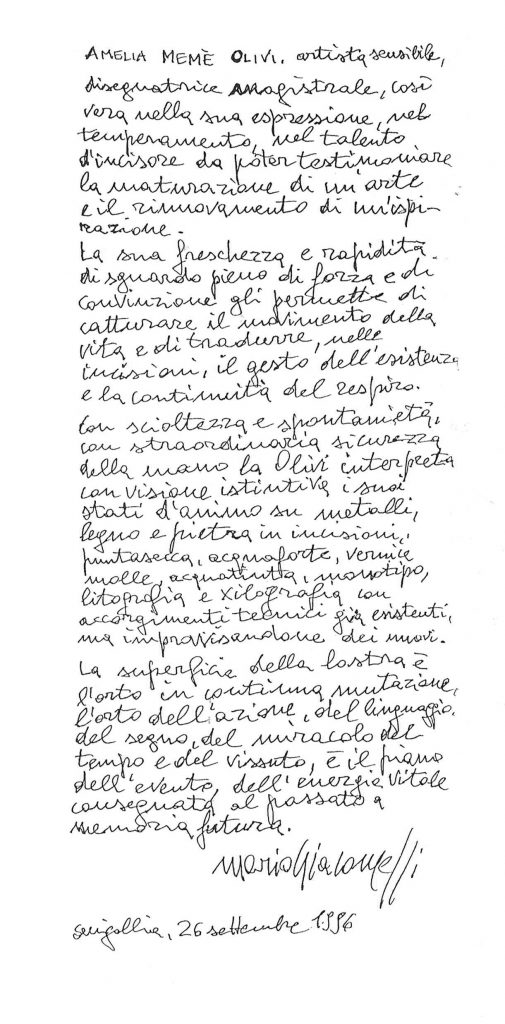
AMELIA “MEMÈ” OLIVI, a sensitive artist and masterful engraver, is so genuine in her expression, temperament, and talent as a printmaker that her work bears witness to both the maturation of an art form and the renewal of inspiration.
The freshness and immediacy of her gaze, imbued with strength and conviction, enable her to capture the movement of life and to translate into her prints the gestures of existence and the continuity of breath itself. With ease and spontaneity, and with extraordinary assurance of hand, Memè Olivi instinctively interprets her inner states on metal, wood, and stone through a wide range of printmaking techniques—drypoint, etching, soft-ground etching, aquatint, monotype, lithography, and woodcut—drawing upon established technical methods while continually improvising new ones of her own.
The surface of the printing plate is a field in constant transformation: the field of action, of language, of the mark, of the miracle of time, and of lived experience. It is the plane of the event, of vital energy, entrusted to the past as a memory for the future.
Mario Giacomelli, Senigallia, 26 September 1996.
AT THE ROOTS OF FEELING
In the contradictory landscape of contemporary art, it is rare to encounter a figure like Memé Olivi: her roots, firmly anchored in the Urbino school, sink into the rich humus produced by the teachings of Bartolini and Castellani, her sturdy trunk is imbued with astonishing technical virtuosity, her branches reach out toward the world and speak softly of her connections with Northern European and American culture.
Hearing the artist talk about her work reveals a curious approach that combines a keen eye for detail with bold technical experiments, combined with woodcuts and aquatints, conducted with the rigor and imagination of an alchemist of times past. They effortlessly indulge the expressive desires of a thoughtful and silent soul, capable of capturing, both in the serene expanses of the Marche landscape and in the paroxysmal writhing of an olive tree, the sense of passing time, a ‘spleen’ typical of the most sensitive years, prone to melancholy.
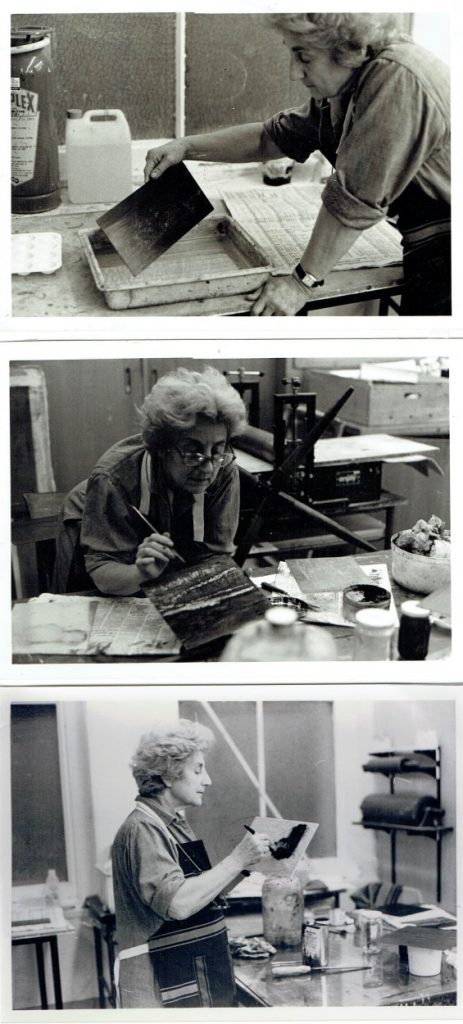
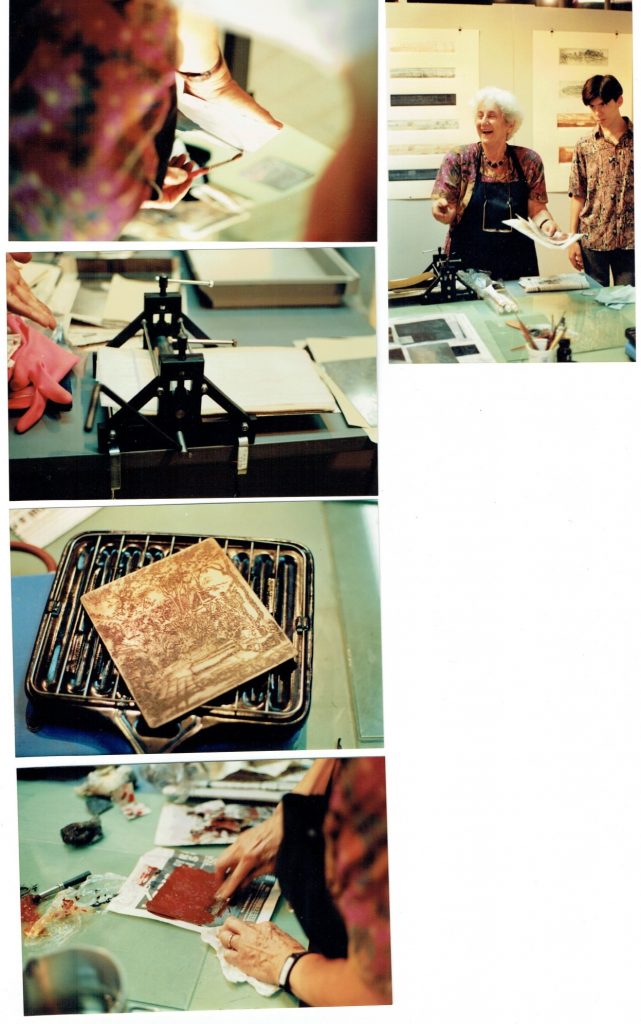
As with the most celebrated engravers of the past, the encounter with the metal plate allows the artist to express her personality, and the etchings preserve the memory of distant experiences, of gentle and rarefied feelings that materialize on paper. The strength of the mark, the physical vigor required to use the press, are placed at the service of a universe of evanescent sensations, otherwise destined to vanish into nothingness, remaining unexpressed.
The desire to share this inner world with others will long fuel the creativity of an artist who knows how to assert herself with the grace of a lady of times gone by, without sacrificing confrontation and contemporaneity. Having emerged from a refined period living room, Memé Olivi has traveled the world, looking at everything with the curiosity of someone who doesn’t let herself be overwhelmed by novelty, always seeking the essence of an otherwise elusive reality.
Stefano Papetti, Florence 1997
ROOTS
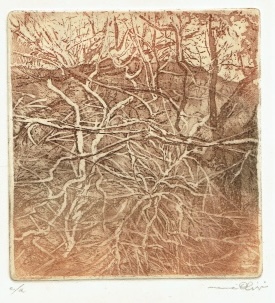
Memè Olivi’s multifaceted and complex artistic activity is emblematically expressed in one of his small works, a tangle of roots that create a labyrinth in which lithographs, woodcuts, and chalcography are condensed and merged. His art is expressed through these three techniques with an imagination and incisiveness that take us back to 15th-century memories, and it is no coincidence that he trained as an artist at the Scuola Superiore di Urbino.
The thread of the drawing never seems to break, giving us landscapes, rivers, vast rolling countryside, and bell towers, making them appear in a dreamlike reality.
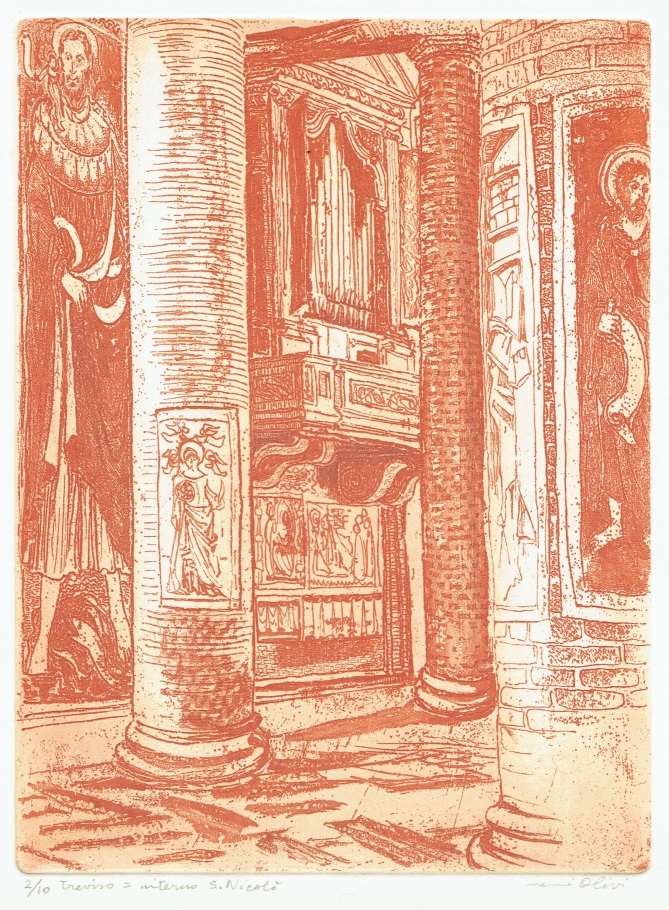
Complex moods return in certain works by Memè Olivi, as in the three images of the church of San Nicolo’, each created with a different chalcographic technique, reviving a distant, blurred, evocative world that feeds ancient memories and melancholy.
Certain undulating rural expanses, similar to dunes, take us into the distant world of fantasy, as if sailing towards the Fortunate Islands, where the navigator would rediscover the maternal voices of his lost childhood.
The tools used by Memè Olivi—engraving, lithography, stones, wood, spatulas, brushes, and burins—magically reconstruct those small cells where patient monks “illuminated” books of hours with the meticulous and patient technique used by our painter.
Her painting conveys messages from all over the world because her instinct has taken her to distant countries from which she has drawn inspiration that bridges distances and allows us to feel, through art, that we are citizens of the world.
Cino Boccazzi Treviso 1994
FOIL
Olivi’s engravings surprise us at first glance by their prodigious technical skill. Everything is meticulous, attention to the smallest detail, respect for each incision, each line. These images restore to us the applied and patient world of miniaturists, with landscapes in which every fragment of nature is present, without any fading or disappearing, creating an impression of depth. Each bottle seems to vibrate in the autumn air; beneath the seemingly calm surface of the water, a universe of black lines stirs, as if they carried the true meaning of color.
After this initial surprise at the technique, we come to understand the unanimous and pantheistic meaning of these representations: love of the earth, communication with all that inhabits and constitutes it, with all that merges into it or, conversely, rises and proliferates as if to escape it.
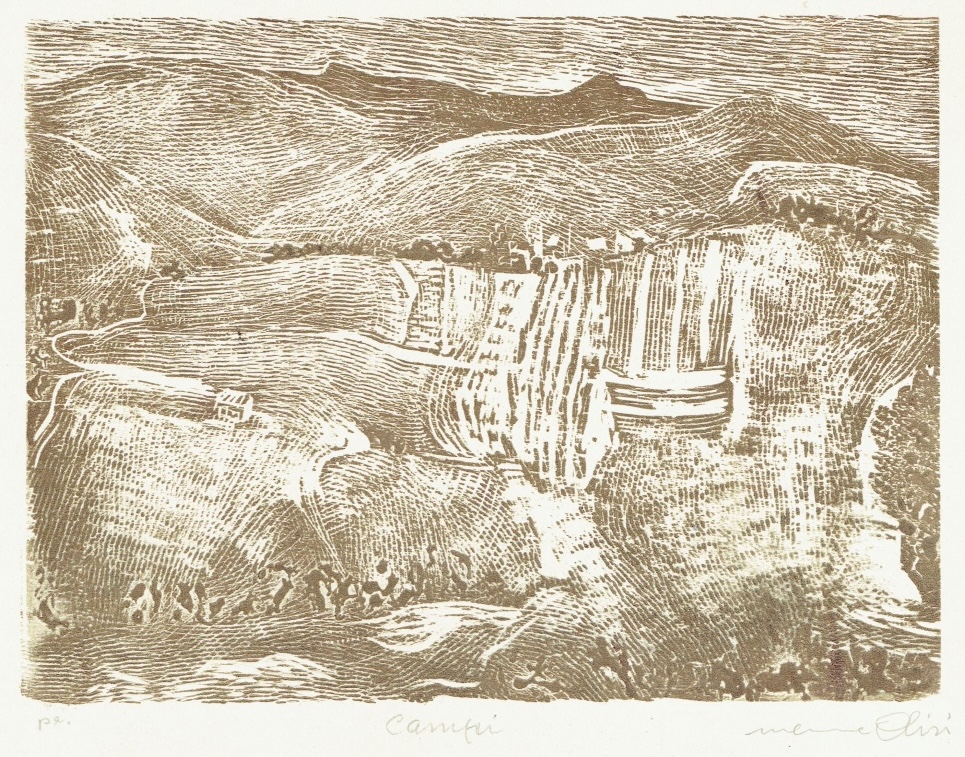
Memè Olivi depicts the earth, but never virgin, nor anonymous, never wild, but already plowed, already worked, and, one might say, already marked by humankind. The furrow erodes the earth like acid or a drypoint needle, like a metal plate.
Trees also appear, distant Gothic cathedrals, unknown streets of Venice, but the work of humankind and time, accomplished on the earth, is always visible: the trees are bare, without birds to enliven this persistent silence; the cathedrals are distant and certainly in ruins; the alleyways of Venice are deserted.
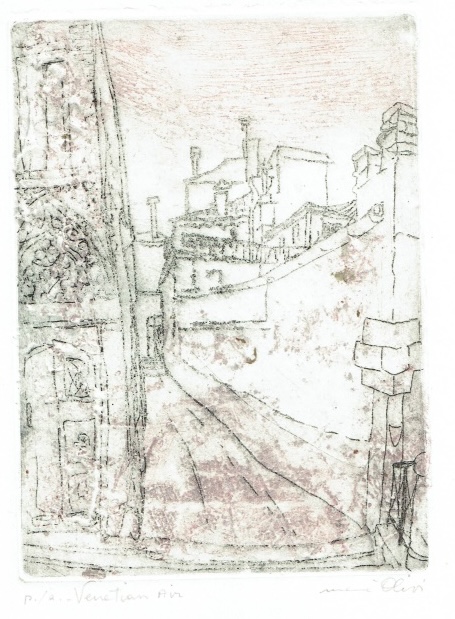
Memè Olivi presents us, with profound respect for materials and a patience bordering on devotion to craftsmanship, with a world of furrows, autumnal and ephemeral.
Severo Sarduy, Paris 1992
THE PLOWS OF THE MARCHES
The plowed fields of the Marches, with their long furrows etched into the earth, resemble a plate striated with a chisel, or etched with acid, by an artist with a perfectly steady hand. And these landscapes of the Marches, her native land, are the theme that most naturally presented itself to Memè Olivi.
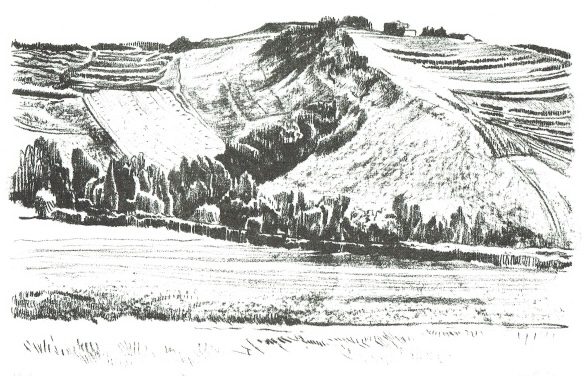
But she soon sets off to discover the world and offers us her personal vision.
Cities: Treviso and its church of San Nicolò,
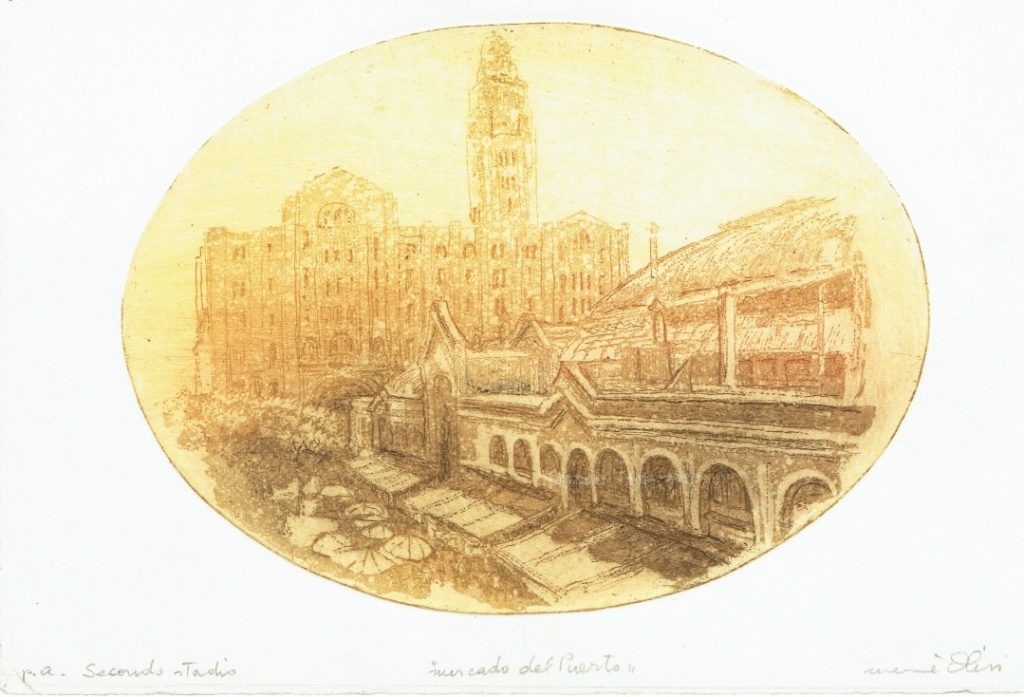
Buenos Aires and Montevideo, the end of Rue Jacob in Paris, where it meets Rue de Seine, Via Margutta in Rome,
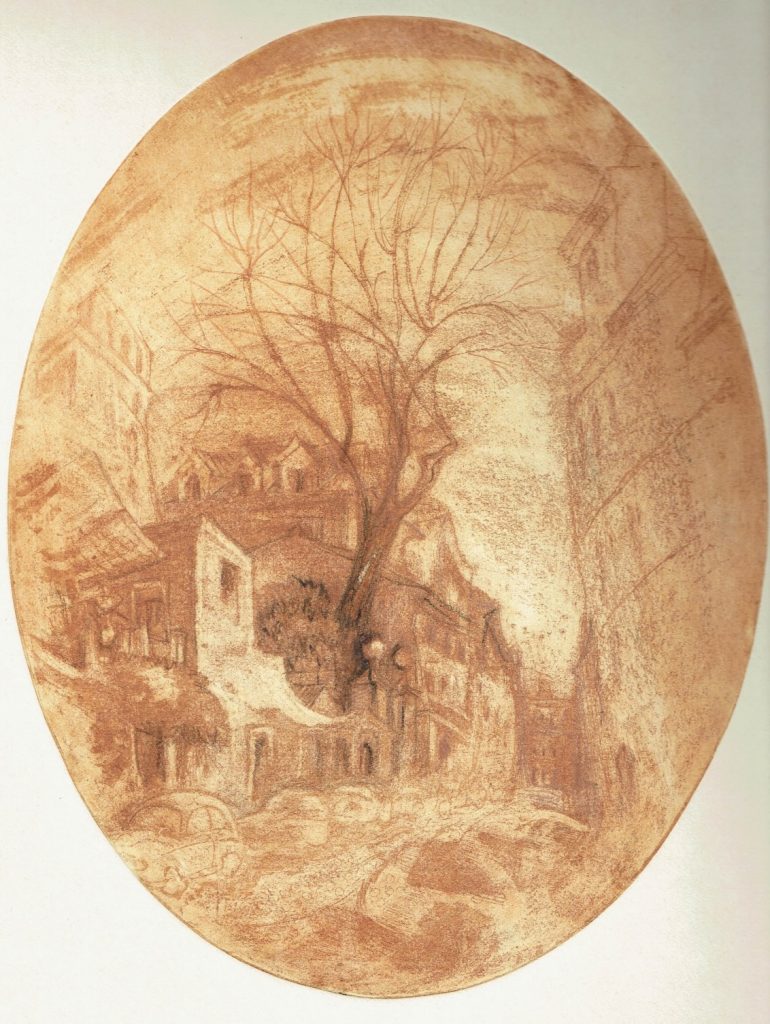
Brussels, the Potomac in Washington,
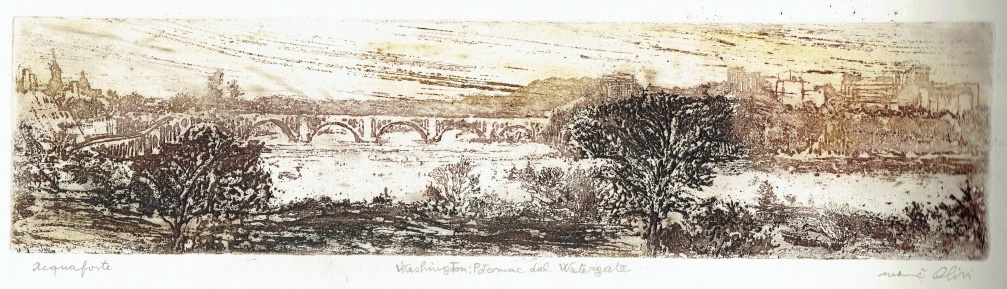
a Baroque palace in Venice, but also the lagoon, in the shifting indecision of water and land. For she is not only the painter of urban geometries. Nature, with its arabesques, captivates her. Whether it be the intricate patterns of the equatorial forest or light thickets, the spectacular Iguazu Falls on the borders of Paraguay, Argentina, and Brazil, or the midnight sun in Lapland, which inspires her to create a curious aquatint.
It is known that Memé Olivi uses all the resources of the engraver’s art, all the methods and techniques that seem so astonishing and marvelous to a layperson. One must hear her speak of the “maniera a zucchero”, the “sugar way”. But through the diversity of processes, you always recognize her. If she shows us in dry point engraving, that she also knows how to create young girls, birds, flowers, she asserts herself in the landscapes. As if they captured her entire attention, they are devoid of humans or animals. And yet, few works are so inhabited.
Roger Grenier, Paris 1996
LANDSCAPE
Meme has often been accused of being solely a landscapist.
She probably accepted this as a compliment as it is her favourite subject and through it she can convey her deepest thoughts and her understanding of the world, of the land and of her origins. But almost as a retaliation to these criticisms she engraved many portraits. She executed one of her daughter in pure engraving. In this the nearly abstract quality of the line evokes the simplicity and innocence of the childhood.
Another gender she successfully attempted is that of the still-life. Their immediacy and strange quality recalls the master of the 19th Century still-life Odilon Redon.
Landscape is the subject that captures most the essence of Memè Olivi’s poetry. Landscape of her native land, the Marche, Senigallia where she was born and raised, and Urbino where she was educated. Memè represents in her Marche landscapes the aridity of the land, the work of men through the centuries to cultivate it, the multitude of fields covering the hills and the mountains, the colours that vary from orange to brown, from ochre to yellow. These detail are caught by Memè with an acute precision of texture. The chisel itself becomes the plough and till trough the paper. There are no figures in Memè’s landscapes, but trees. They catch the movement, they represent change when the land has not moved for centuries.
To confine Memè to the Marche would be unfair as she is a keen traveller: she has explored not only Treviso and the Veneto where her husband comes from, but also countries of the five continents. And from most of these countries she brought back hundred of drawings that she later used in her prints. Though now in the last stage of her career, Memè has the enthusiasm, the energy of a young artist, but the experience of someone who has worked for more than titty years.
Nicolas Schwed London 1997
ARTISAN
Memè Olivi likes to introduce herself as an artisan and emphasizes her craft. She has mastered all the techniques of printmaking—lithography, woodcut, etching (aquatint, drypoint, aquatint)—and doesn’t hesitate to modify or combine them, according to the needs of expression or simply for the pleasure of experimenting.
For the enthusiast or the artist, it’s a delight to discover her workshop and listen to her speak about her work, without pretense, with a warm and lucid simplicity. Like a true artisan.
The variety of techniques naturally corresponds to a variety of styles, but prints made using the same technique also display remarkable diversity: limpid outline or dense network, monochrome (more or less nuanced) or polychromy (always restrained), uniformity or effects of superimposition (an admirable virtue of the lithographic pencil), airy lightness or earthly gravity.
Technical and stylistic diversity is always a sign of talent: fueled by imagination and fantasy, it undoubtedly represents the highest degree of craftsmanship. Memè Olivi’s work possesses all these qualities, and I would like to show that it is also structured and underpinned by a unique, artistic sensibility, which gives it its profound unity and confers upon it, for us, its full value.
Oscar C. Pecora, Buenos Aires 1994
INVENTORYING
To inventory a vocabulary based on technique seems like a daunting task. But to glimpse, with the delicate eye of Memè Olivi, the subtlety of the diverse impressions in his work within that infinite tapestry is already a wondrous moment. The strange movements, the effects of acid, water, paper, the gesture that reshapes the line of a landscape that spills further into oneself, all of this leads us to a world imagined through dreams.
Carlos Colombino, Asuncion 1992
The etching ” Sole di Mezzanotte” (“Midnight, Lapland”), visually stunning, stems from an impression she attempts to render, distilled: the ice, the cold, this red-orange sphere, the space. One thinks of Baudelaire’s line: “And like the sun in its polar hell”, but the apprehension here is one of an oriental serenity.
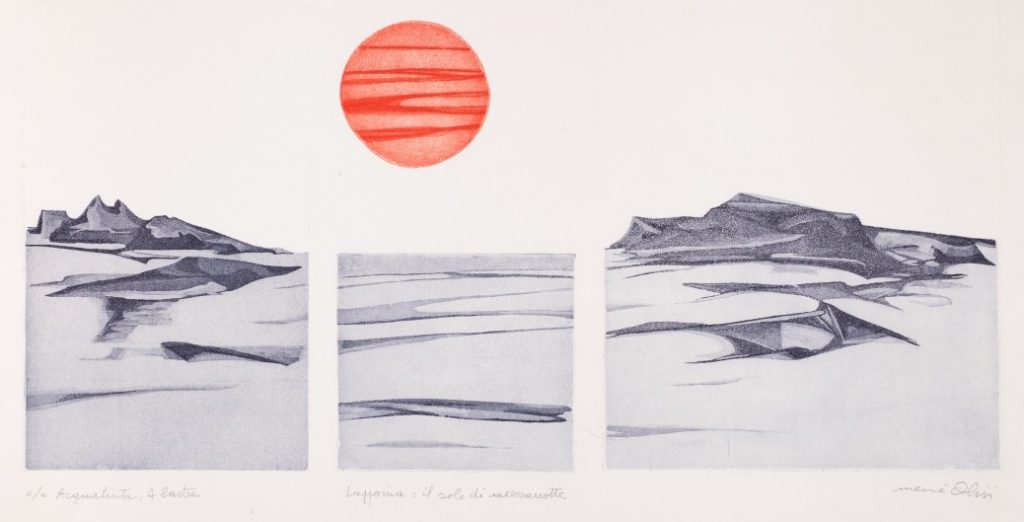
In fact, the affinity between this engraving (or even “Lagoon”, with its delicate bundles of lines) and Japanese aesthetics is surprising, although difficult to define precisely: simplicity, purity of lines, whites, stylization… A beautiful fruit of a loving contemplation, which seeks to arrive at the essential, poetic.
Memè Olivis’s gaze is very sensityive to the architecture of appearances, and strongly perceives the lines; better yet: her gaze explores the internal structure of things. Her glaciers are more than even subtle and nuanced “images” of glaciers: they have weight and presence. This vision can only be expressed through a perfectly mastered technique: the variations in color that convey it correspond to longer or shorter exposure times (to acid).
In the lithograph entitled “Solitudine” (“Solitude”) the artist rarely allows himself such an expressive title), we find ourselves once again in a stark, splendidly inhuman space.
The atmosphere is more somber, somewhat painful: strong lines, dense color, armature, and, at the center, this powerful interpenetration of two geological masses, the site of an obscure gestation. The work is powerful because of this central movement, a muted dynamism, to which the energy and intense blue of the upper horizontal respond.
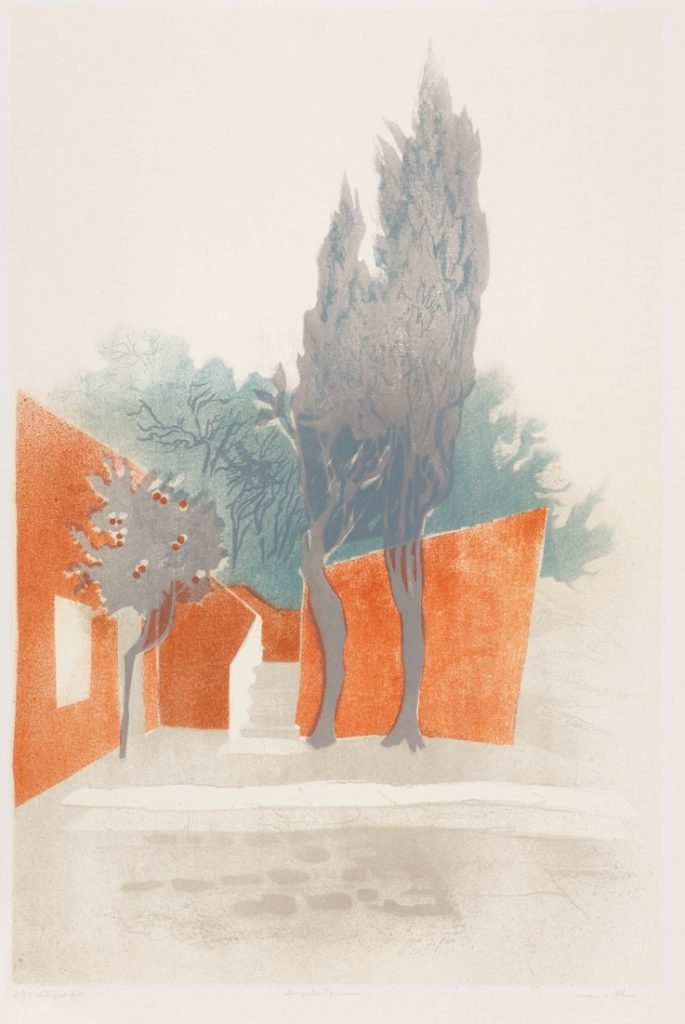
The inspiration for “Angolo toscano” (“Tuscan Corner”) is very different. Here, fantasy and dreams triumph: the geometry of the house, which initially captivated the eye, is negated, replaced by the exuberance of the trees with their fiery, fantastical forms.
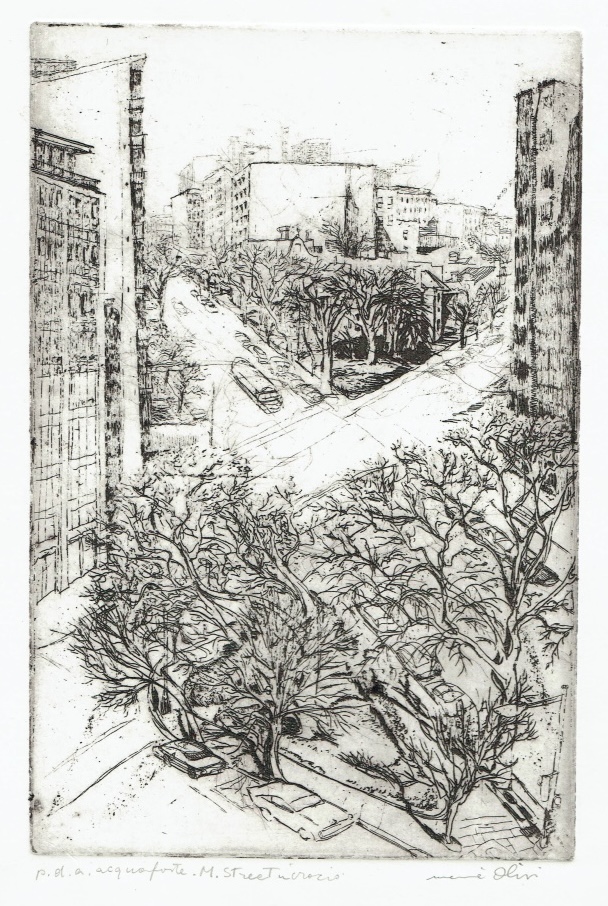
Although in “View of Washington” the atmosphere is no longer symbolist, tinged with mystery, the fantastic has not disappeared: the imagination takes advantage of a seductive intersection to open two trench-perspectives in the oppressive geometry of the City, returning it to Space; in the foreground as in the background, skeletal but vigorous trees, as if furious, vengeful, seize the urban space… Movement is everywhere (one can even identify unforeseen but accepted lines, results of scratches in the copper plate), cosmic, liberating.
Of all the techniques used and valued, wood engraving is my personal favorite.
The resulting prints possess a rich materiality that begs to be touched. Moreover, I sense it is particularly dear to Memé Olivi: the artisan’s imagination revels in the (manual, visceral) struggle with living matter, while the artist’s eye passionately scrutinizes the wood’s apparent texture.
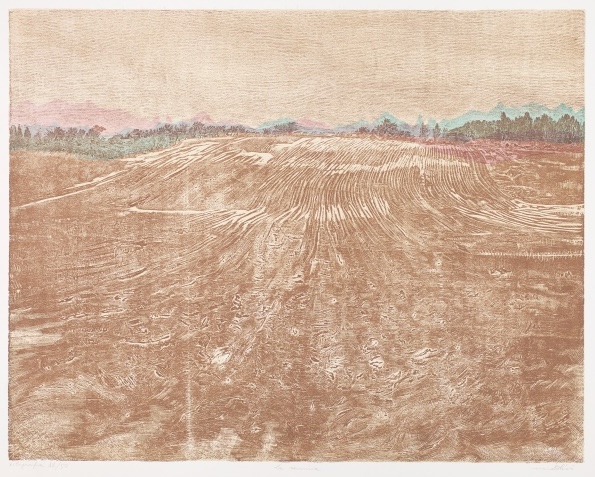
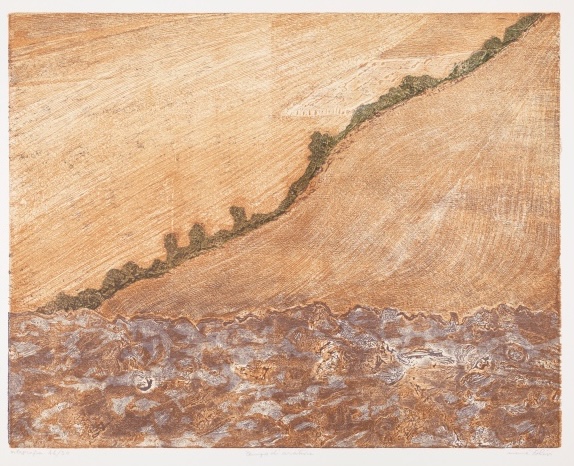
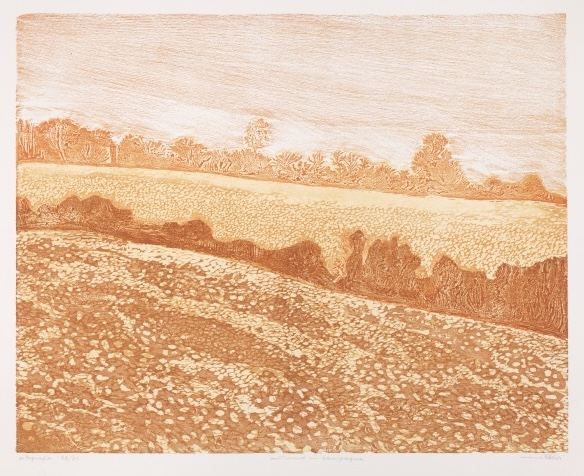
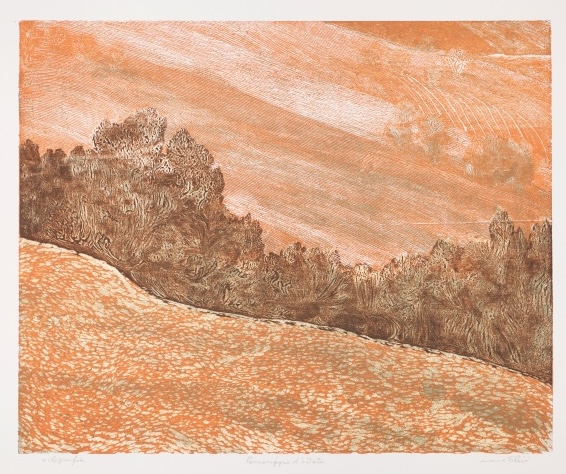
“Tempo di aratura” (“Time of Plowing”) could well encapsulate the essence of Amélia Olivi’s artistic vision. First, there is the love and revelation of Space, inseparable from the love of Nature: here, expanses of land are energized by transverse lines, like vanishing points. This “dynamization” (setting in motion and energizing) of the seen is a constant tendency (see “Tuscan Corner” or “View of Washington”), which is rivaled by serene contemplation (the line relaxes, stretches peacefully, pensively). Next, this passion for the structure of being and the desire to reveal it: observe, in rich tension with the overall dynamism, the architectural firmness of the contours and, above all, more profoundly, simultaneously with the immediately perceptible internal structure of the wood, that of the landscape (the lines of the terrain, the disturbed earth, revealing its inner workings…). Finally, further affirming this compactness of being, a “flattened” perspective, which tends to nest the volumes within one another. Only a few woodcuts would be exceptions to this kind of perspective, where precisely a lyrical evocation of space prevails over the analytical gaze; “Semina” (“Sowing”) surprises with its depth of field and the convergence of vanishing lines, accentuated by a descending-ascending effect that compels the eye to embrace and caress the expanse, the earth swelling and pulsating like a breast… Then Tempo di aratura admirably conveys the passion for the structure of being and the the desire to reveal it: to observe, in rich tension with the general dynamism, the architectural firmness of the contours and, above all, more profoundly, at the same time as the immediately perceptible internal structure of the wood, that of the landscape—the lines of the ground, the earth upside down, showing its entrails…”
Robin Lefere, Bruxellles 1992
PLACES OF MEMORY
Memè Olivi’s scholarly work conveys a Leopardian sense of nature, evoking memories of centuries past and a poignant nostalgia for familiar places and dreamt-of lands. Those born in the Marche region carry within them the image of a gentle landscape that opens onto undefined spaces, but only a true artist, who knows the patience of ancient techniques, can express in writing that speaks even to those who do not know the language of art, what can only be seen with the eyes of the soul. This is what Giacomo Leopardi expressed in his famous reflection on “double vision.” It is on this ability to see inside things that the poet built his Canti. The sensitive artist who has learned Leopardi’s lesson bends images and techniques in search of a way to capture in a landscape the magical moment of the real and the unreal, of time and what is timeless, of the everyday and the eternal.
The perfection of techniques, the fruit of patient research and an ability to create effects never before experienced, sums up the knowledge of centuries, which risks being lost in a present without memory. Memè, without using traditional colors, creates effects that suggest the unsaid, beyond the landscape. One cannot help but think of this reflection by Giacomo Leopardi, who thought about painting much more than critics have said and saw much more than appeared.”We love and find beautiful a landscape painting because it reminds us of a real view, a real landscape, because it seems painted to us, because it reminds us of paintings. The similarity of all imitations (remarkable thought). Thus, in the present, we only love and find beautiful what is distant, and all the pleasures that I would call poetic consist in the perception of similarities and relationships, and in memories. “
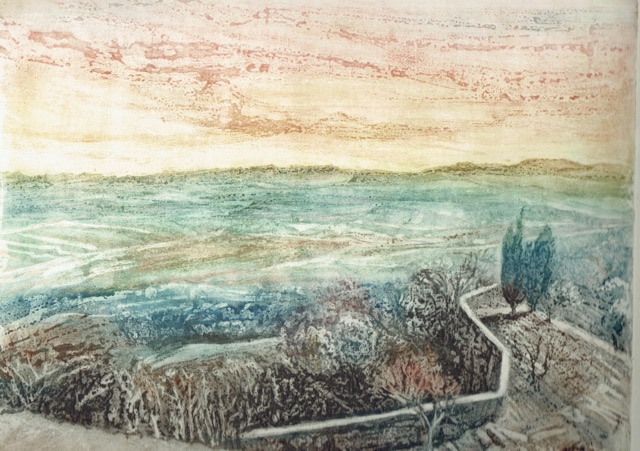
Poetic pleasures, similarities, and memories are all present in Memè Olivi’s engravings, which seem to crystallize the poetic meaning of Leopardi’s places, which are not only those of Recanati or the Marches, but those of a large part of the wider world in which the artist lives. Thus, memory filters and transforms reality, fixing it in a kind of silent space and timeless time, open to the imagination.
Franco Foschi, Recanati 1998
THE POETRY OF ENGRAVING
A region of magical enchantment and restless spirits, the Marche has produced many masters in the field of engraving. From Federico Baroccci and Simone Cantarini to two distinguished wood engravers of the caliber of Adolfo De Carolis and Bruno da Osimo, a subtle thread runs through them all in the name of etching. This rich humus is part of the cultural background of Memè Olivi, who trained in Urbino at the school of Bartolini and Castellani. She has been able to distill what she learned from her masters with sensitivity, achieving a technical competence that is evident in her mastery of woodcut, lithography, and metal engraving.
Without debasing her creations by producing dozens of prints, Memè Olivi seems to yearn for the unique specimen, coveted by Andrea Sperelli, the amateur chalcographer who is the protagonist of d’Annunzio’s “Il Piacere”. But technical expertise alone is not enough to make a great artist, who must also possess an extraordinary sensitivity capable of grasping the lyrical aspects of reality and interpreting them in the light of their own feelings: it is this aspect that shines through in Olivi’s new series of engravings inspired by Leopardi. Sometimes the name of the great poet has been exploited as a vehicle for mediocre artistic productions, as happened in the 17th century when, based on Horace’s concept of ut picture poesis, the poems of Tasso and Ariosto were plundere by many “petits maîtres” in search of inspiration.
In this panorama of figurative reworking of Leopardi’s world, Memè Olivi’s engravings arise from a conscious lyrical revisiting of the places dear to the poet, avoiding truly illustrative temptations: this is demonstrated by the sheets dedicated to the ‘paternal hostel’ and above all to the library where the ghost of the young Leopardi seems to linger, still engaged in his ‘graceful studies’ conducted in the shady and solitary rooms, surrounded by his beloved father’s volumes.
Retracing the genesis of each engraving through a comparison of the various ‘states’, reconstructing the refined fusion of woodcut with metal engraving, imagining the trepidation with which the artist awaits the bites, we can see the long work that lies behind each of these sheets, light as paper but incisive as the poetic intuitions born of a strong imagination can be: the one that for Leopardi generates the “… serious, passionate, ordinarily melancholic character, profound in feeling and passion, and entirely prone to suffering greatly from life” (Zibaldone, July 5, 1820), which we believe we recognize in Memè Olivi’s work.
Stefano Papetti, Florence 1998
-In 2014, the studio on Rue Jacob in Paris was renovated to provide even more space for Memè Olivi’s work
Visual artist Rebecca Fabulatrice selected some of Memè Olivi’s plates and created a work entitled “Memè Olivi says”
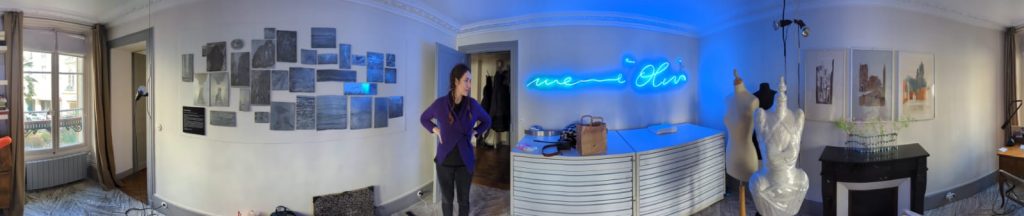
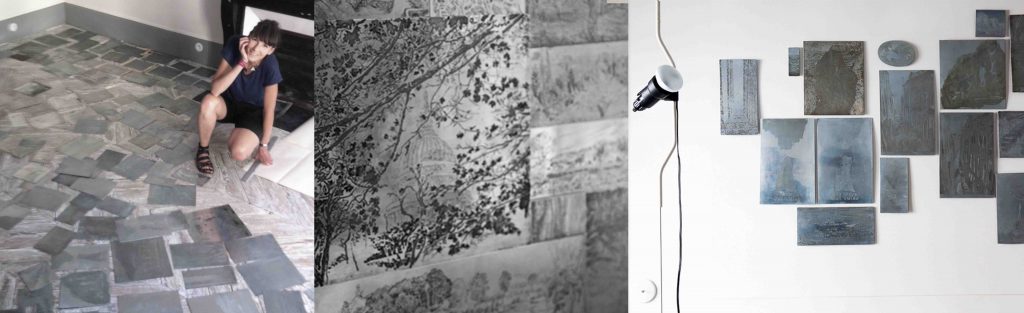
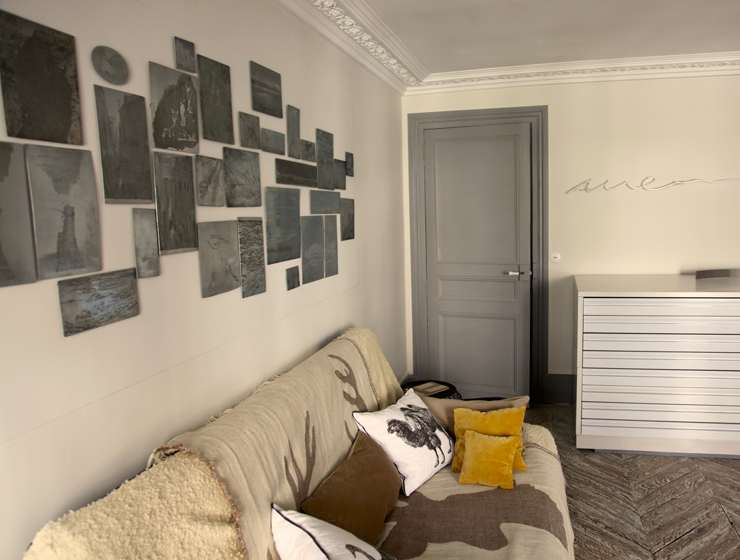
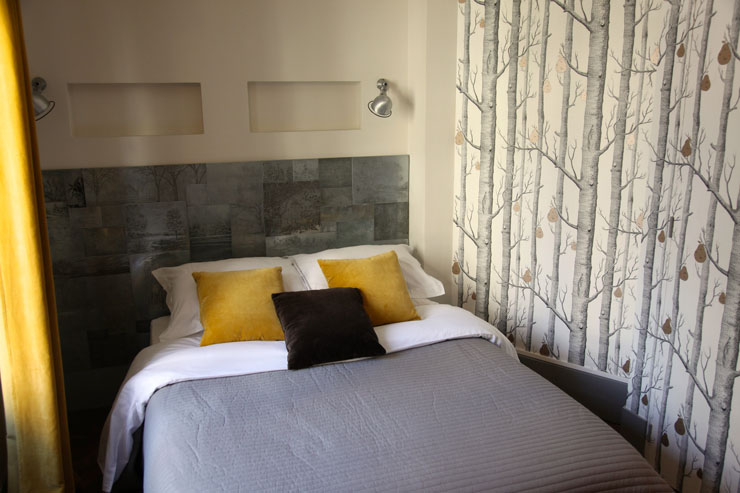
“ Memè Olivi dit ”
Text accompanying the engraving plates, in reading order.
“Yes, well… I think about it and then I forget, I forget before perhaps… I no longer know. I disappear, that much is certain. I am a blank plate, a silhouette, a pale stain. But not always… Wait! Now that I think of it—or perhaps remember—my favourite landscape, my theatre and its watery streets: Venice! With its cats, so many cats, and what cats they are! Leaning at the window, and though I am disappearing, I can still see them. They play at survival, scratching and killing those poor birds… Gone—nothing left but feathers on the water. Well… even for Venetian cats, water remains a mystery, just as it does for me. Sometimes I imagine by what obvious magic it leaves the city for the lagoon, stretching out its great arm toward the grasses standing in the wind, where the land is almost no more. Even blurred, the lagoon is still something I believe in, right to the edge of the landscape, to that far boundary where there are still huts of claws. Claws… a whole existence made of claws, of tool marks. On the plate. Yes, the trace of my life, sequence after sequence—it is engraved there… and even if I am Meme, then I do not forget. And you?”
Rébecca (!) fabulatrice – Composition 2014
MY MEETING WITH MEMÉ
My meeting with Memé came about thanks to a fortunate combination of geographical and human circumstances. In 2019, in the large garden of the Gambini Rossano house in Senigallia, I met Olivia. She was busy with the renovation of the house that had hosted Memé during the hot summers in the shade of the tall maritime pines, and amidst the boxes, attics and cellars, she showed me some lithographs by her mother, who had recently passed away. Senigallia was the zenith of these geographical coordinates that wind and unravel amongst those who leave and those who stay, leaving everyone the chance to return in August and meet again in the shade of the pines or the parasols. Just as had happened to me in previous years when, having set out to find my place in the world, I left my city to end up in Trentino at the Depero art school in Rovereto. Here were Anna and Silvio (especially Anna), who in this story represent the hub of a network that fate brought together.
The story was much the same: women, artists, who had overcome prejudice, fear and distance, and set out to pursue their dreams. When I told Anna and Silvio about Memé’s life, it didn’t take them long to grasp the poetry of this story. The story of a woman who, on her own in the 1920s, had made a name for herself in the art world—a world already underpinned by extremely strong patriarchal tendencies—in the fields of chalcography and art printing, blending in amongst the masters of Urbino, all of whom were strictly male. When Olivia showed me the draft of the film they were shooting, I immediately empathised with the female characters being portrayed.
The narrative was woven from the threads of three personal stories: three generations of women—Memé, Olivia and Amélie, grandmother, mother and daughter—bound not only by life but also by a shared passion for art, bearing witness to the universal struggle of women from all walks of life to make their mark in a world still too dominated by men. Here, amidst the light and shade of these events—delicate yet powerful—and in the spirit of an innate solidarity with those fighting their own battles against stereotypes and prejudice, I glimpsed the opportunity to support and share a story that had done me good to hear, and I hope it may have the same effect on other sensitive souls.
Paola Mancini, Senigallia April 2024
Creation exists as a genesis beneath the visible surface of the work.
Only intellectuals can see it looking back; looking forward – into the future – only artists can see it.Paul Klee
The story of Memè Olivi is truly an extraordinary adventure in which the most diverse forms of artistic experimentation intertwine and seemingly distant artistic worlds engage in dialogue. Memè is a forerunner of the figure of the tireless, multifaceted artist who traverses time, places and territories with a joyful determination. Always on the lookout for inspiration and stimuli, always within art as her vital lifeline.
I did not know Memè personally, but in viewing her body of work—from her early engravings and illustrations to her fashion designs—I encountered her and discovered the clarity of her vision, her ability to expand whilst adhering to a rigorous working method, whilst simultaneously following a precise poetic path. Her entire body of work is compelling precisely because of this strength, because of her constant yet unhurried desire to delve deeply into the realities of life, beyond the surface, beyond appearances and the visible, probing within every single subject in search of spaces and traces for a life to be lived in complete freedom.
A forward-thinking, courageous woman who, through her art, fully expressed the joy of creative action. This is what unites true artists.
Silvio Cattani, Rovereto 2024
Being able to host this exhibition dedicated to Memé Olivi in Nogaredo during the twenty-fifth edition of “Calendimaggio delle Strie” is a source of great pride and honour for us, not only because of the prestigious artistic connections – including international ones – that the exhibition offers, but also because she is an example of a tenacious and determined woman who embodies the very spirit of the event.
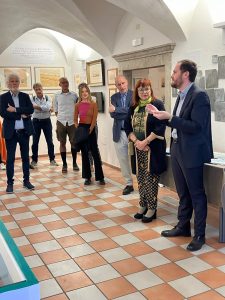
Celebrating women, their creativity and their charisma is the aim of this exhibition, as it has been of others that Calendimaggio has presented to our community over the years.
An exhibition that is sure to leave its mark, just as the technique—engraving—that Memé Olivi uses to create her works does, where the expressive power of the line blends and merges with the peace and serene, meditative tranquillity of the landscapes depicted. The documentary film about her life will also highlight the artist’s more human side, as she was first and foremost a daughter, wife and mother.
Our thanks go to her daughter Lilli, who firmly believed in this project, to Silvio Cattani, to MART and to all those who, in various capacities, have enabled us to discover this extraordinary artist of the Italian twentieth century.
Alberto Scerbo, April 2024
FLYING THE SENIGALLIA FLAG
When you’re born in a place that does this to you – that wraps you in the gentle embrace of soft, flower-covered hills and draws you towards the shimmering green-blue horizon of the sea – those bonds are unlikely to ever break.
Then there is the (childlike) certainty of having grown up in a special place, with special people, so you fly the Senigallia flag for life!
I left Senigallia early on, but that little ache—sweet as a mole, like a birthmark, like a hard cherry stone—has settled beneath my heart. It is because of this nostalgia that I have embraced and welcomed into our home every person from Senigallia I have met along the way.
So when Paola Mancini, daughter of historians and dear friends, told us about Memè Olivi, Silvio and I were utterly taken aback.
No, I couldn’t have known him; I was away and she was far off too, but the power of her message now reached us, full and mighty as a gust of bora wind on the rocks!
How refreshing her vision of our hills, shady and smiling, furrowed by the plough, toiled over by men, caressed by gazes!
Then the innovative message in the search for an ethic of freedom in the affirmation of her being an Artist!
Anna Lorenzetti, Nogaredo April 2024
The art of parenting
What happens, what goes on between Memè Olivi and her granddaughter – between the landscapes of severe sweetness depopulated by men and animals of the grandmother, the great engraving artist, and the colorful serigraphs of her brilliant granddaughter Amélie, in which human beings affected by strong psychic anxiety dominate – a Renaissance head of skinned, surrealist pipe-rolling convolutions, or delightful pre-adolescents who rain down in the instability of uncertain youth lurking?
Of course, the link is there; starting with the auspicious name given to the little girl, almost already a destiny. And the mysterious bond, which allows Amélie to draw in the corner of her grandmother’s studio – from which they were all firmly kicked out (“Stop!”, Memé used to stop them, as evoked by her daughter Olivia (and for all Lilli:) who,of course, remembers Memé’s dedication to family affections, knowing full well that they were damaging her work as an artist).
There is the extraordinary technical knowledge of Memé Olivi, who used her burins as if they were scalpels, precise, rational, and as if they were beneficent and providential, then rendered suffused with the dots of aquatint, the mild colors, the browns, the soft greens, and the rolling hills in distended waves; and, above all, always from a moral and affective vision of her industrious Marche, reserved and silent even in the midst of her laboriousness (and Roger Grenier rightly says, of her human-less landscapes, that there are “few works so inhabited”).
From the age of five , Amélie was able to rely on the technical training of her grandmother, who had in turn matured her through a lifetime of “study” (so Memé says continually in interviews). But there is a deeper connection, so it is impossible not to think about Marcel Proust: Proust dedicated many poignant reflections to these transmigrations of physical and moral traits from mother to sons, and some of his most beautiful pages. In the long mundane scene in Sodome, the two sons of a lady, Madame de Surgis, appear: “We met two young men whose remarkable and dissimilar beauty originated from a single woman…They shone with their mother’s perfections, but each with a different one. One had transfused in him the same royal bearing and the same fiery, reddish, mother-of-pearl pallor … his brother had inherited the Greek forehead, the perfect nose, the statuesque neck, the immense eyes. Each son translates, illustrates and reveals a different mother.” Between letters and requests for confirmation, Proust questions this singular theme, an extraordinary reversal of time, where the children develop a different mother. Proust’s letters to friends, witnesses to his reflection, date from his end, 1921; but the theme already appears in one of the earliest passages of La Recherche du temps perdu recently discovered in the 75 folios (1908). There, Proust overturns the regular movement of biological time, and does not interrogate the son’s face to find, as in a monstrance, traces of the mother’s, but conversely reads in the mother (in her ‘profaned’ face) the traits of the degenerate son (de-generated: presenting an alteration of the lineage). Perhaps it is an improper forcing, but in Memé Olivi’s latest works, when from a single matrix she creates several works by changing the color, and operating almost like an oil painter, or when she suspends a sun, a circle of sharp and vivid hue, in a Nordic landscape, how could she conceive it, all in formal abstraction, a Japanese xylographer, I thought it reflected à rebours the intensely colored production of her granddaughter Amélie, as if ,by a reversed influence. -But, perhaps, it is the work of the time that, for both Amélie, was initiating the modern towards more conspicuous experiences and unprecedented coloring.
Daria Galateria, Rome March 2024
Memè. You were, and still are, so dear to us. Gentle, kind, affectionate: an important presence in our lives. A true artist. An intelligent, witty and sensitive woman who lived her life to the full and left her mark on her time, remaining true to herself through both success and adversity.
We have always felt you very close to us, so very close, even though you are no longer with us. Something of you – your smile, your affection and your wit – we will always carry with us. With love and with such longing for you, for the years of our youth when we first met you, and for Rue Jacob.
Paolo and Gabriella Franchi, Rome 30 september 2019
THE INFINITE LINE – GENERATIONS IN CONTEXT
For this exhibition project, we have chosen to retain the title “The Infinite Line”, which is taken from the beautiful film about the life of the artist Amelia Olivi – known to everyone as Memè Olivi – featuring the memories of her daughter Olivia Olivi and her granddaughter Amélie Barnathan. The feature film, directed by the American filmmaker Amie Williams, focuses on the family bond between Amelia (1922–2019) and her granddaughter Amélie (1991), both united by a passion for drawing, representing and documenting different eras and experiences. Our exhibition aims to reconstruct this bond, which also serves as a narrative of different historical moments, from the Urbino School—which we reference through Amelia’s engravings, which are ‘marks’ of our natural environment and derived constructions—to the stories of women and girls depicted in Amélie’s allegorical and dramatic scenes. The exhibition of these diverse artistic experiences within the same spaces is not merely an inevitably unsettling generational comparison; it is also an opportunity that allows us to reflect on the years of change in our natural environment, through a historical and cultured series of engravings created with particular sensitivity by Amelia. The contemporary work is undeniably harsh and dramatic; the narrative is layered with the seemingly violent tones of watercolour red.
Amélie, for linguistic reasons, shares the printing plate, creating eight prints in homage to her original inspiration. These are stories of women who offer us their vision of the world and whose work enriches our exhibition programme. Through the work of the Centre for Studies on Women in Contemporary Visual Arts, we are even more motivated when, as with this initiative, we succeed in tracing a timeline that, starting from the artistic tradition of our region, brings new contributions in the form of fresh reflections on the present day. A time of contradictions? Of multiple identities? Certainly an era of change, including violent upheavals, and of evident political, social and economic challenges. Our task is to document the contemporary, what women’s art expresses and offers us, and to raise awareness of the artist’s work by making their research visible. I would like to thank Olivia Olivi, Amélie Barnathan and our own Simosna Zava for this rewarding opportunity, and for their work, care and patient preparation of this new and unprecedented project.
Stefano Schiavoni, Director of the Nori De’ Nobili Museum, June 2025
THE ARTISTIC MEMORY THAT UNITES TWO FIGURES
‘She has always been waiting for you in the forest within you, a towering woman sitting by a blazing fire. “Even as you traverse the shattered darkness to forge diamonds from it, or the desert that strips you bare yet sustains you with its hidden water; even as you must undress by the river to be lifted over the rapids by invisible hands… despite every struggle… the great, great woman, with all her spirit, awaits you.”
Clarissa Pinkola Estés, The Dance of the Great Mothers.
Memè Olivi’s extensive artistic output, at the heart of the exhibition The Infinite Line, focuses on works created using her favourite engraving techniques – lithography, woodcut, chalcography, etching, drypoint, aquatint – and takes us on a journey where art reveals itself to be boundless. In this synthesis of years of work, silent landscapes, natural vistas and urban scenes from the second half of the twentieth century emerge, bearing witness to her profound dedication to technical exploration and a sensibility nourished by great culture and experience. But what strikes me most, looking at the images of Memè working at the press, or whilst she was painting, immersed in the creative act, is how much joy shines through her gaze; the joy of creativity, the naturalness of being a ‘character in action’.
And so the creative process becomes a necessary condition for existence, for self-expression, for giving voice to a deep and intimate feeling, transcending any role, circumstance or historical era. Hers is an authentic need for expression, which translates into a universal language: every work carries memory and history, in a visual narrative that speaks to everyone. Stefano Papetti writes of her: ‘As with the most celebrated engravers of the past, the encounter with the metal plate allows the artist to express her own personality, and the etchings preserve the memory of distant experiences, of gentle and rarefied feelings that materialise on the paper. The power of the line, the physical vigour required to operate the press, are placed at the service of a universe of fleeting sensations, otherwise destined to vanish into thin air, remaining unexpressed.’ Memè’s work thus takes the form of a way of life, spanning past, present and future, reaching us today through the work of her granddaughter Amélie Barnathan.
The artistic bond between these two figures is portrayed in a poetic and evocative manner in the film “The Infinite Line” by director Amie Williams, from which the exhibition also takes its name. The film offers us precious glimpses into the lives of Memè and Amélie: two women, two artists, who lived in different eras, with their own distinct stories and modes of expression, yet united by a subtle, timeless thread that serves as a conduit for a profound legacy and which, at times, seems to emerge directly from Amélie’s meticulous watercolours, as if to preserve the full intensity of their stories.
Simona Zava, June 2025
A NEW COMMITMENT TO PROMOTING CONTEMPORARY ART BY WOMEN
It is with great pleasure that I present the exhibition La linea infinita by Memè Olivi, a new and significant artistic project that enriches the Nori De’ Nobili Museum’s 2025 cultural programme.
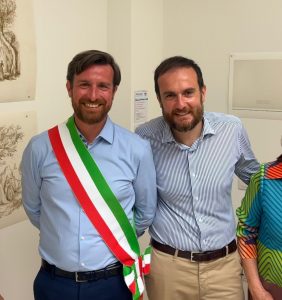
With this exhibition, the Nori De’ Nobili Municipal Museum renews its commitment to promoting female talent in contemporary art, placing a figure of extraordinary significance at its centre: Memè Olivi. The exhibition, hosted in the galleries of the Centre for Studies on Women in Contemporary Visual Arts, presents a selection of works that recount the artist’s tireless creative journey, bearing witness to a life and career that began at a very young age and was marked by moves to cities such as Rome, Florence, Brussels and Paris, as well as a deep and unbreakable bond with the Marche region, where she was born.
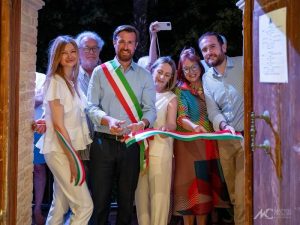
Further enriching the exhibition is the contribution of Amélie Barnathan, Memè’s granddaughter and a young artist based in London, who represents an ideal generational link, capable of bringing continuity and new life to the family’s artistic legacy. Amie Williams’ film, La linea infinita (The Infinite Line), from which the exhibition’s title draws its inspiration, is undoubtedly an added value within the project, allowing viewers to immerse themselves in the life stories of Memè Olivi and Amélie Barnathan.
“La linea infinita” is a major cultural event, designed to engage local residents, visitors, young people and enthusiasts, promoting art and culture through a lens that focuses intently on the female experience.
The project, which helps to enhance the prestige of our municipal museum, is sponsored by the Commission for Equal Opportunities between Men and Women of the Marche Region and organised in collaboration with the Carlo Emanuele Bugatti Association – Friends of Musinf.
Marco Sebastianelli, Mayor of the City of Trecastelli, June 2025